A QR tag that gives a stranger something useful to do.
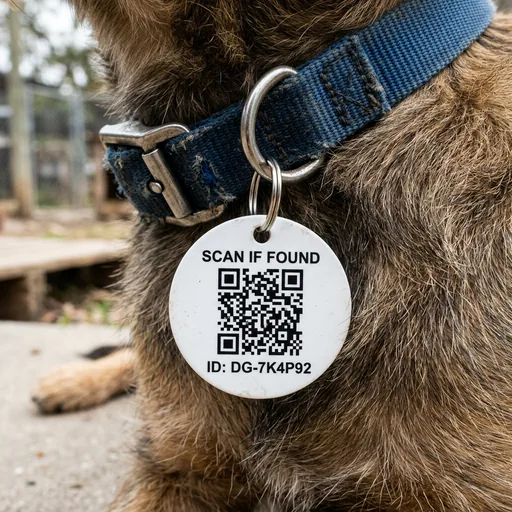
When a dog slips its collar, the hard part is not searching. It is that the person who finds it has no way to reach you. A printed tag on the collar turns that person into a phone call, and every sighting that comes back carries a location.
- No app for the finder
- No account needed to report
- Location reaches you only
- Free reprints, forever
What happens between the dog going missing and you hearing about it.
Five steps, and only one of them needs an account — yours.
-
The animal goes missing
The care team marks it lost. Its record is already there, because the tag pointed at a record rather than at a piece of plastic.
-
Someone finds it
A passerby sees the tag. Their camera opens it. There is no download, no login and nothing to read — the page tells them who is looking for this animal.
-
They report what they saw
The profile offers a sighting form. The finder can send the location their phone recorded, which is usually the single most useful part of the report.
-
The report lands with the care team
Sightings are held against the animal and read by the guardian and the organisation looking after it. They are not published, not visible to other visitors, and not shared with anyone else.
-
Someone collects the animal
A direction and a phone number are usually enough. For a lost animal the profile shows its care team's number, because a number nobody can reach is not a safety feature.
Three things this does not do, stated plainly.
A product that promises live tracking for a printed QR sticker is lying about what it is. Here is what is actually built.
It is not a tracker
There is no battery and no radio in the tag. It cannot tell you where the animal is by itself — it depends on a person being close enough to scan it.
It does not send email alerts
A sighting is recorded and read in the console, by the people already looking after that animal. We have not built automatic notifications.
It does not work without a connection
The tag needs a profile behind it and the finder needs signal to load it. Records live on the server; they are not cached on the device for offline reading.
Recovery depends on somebody noticing it and picking up a phone. A tag raises the chance of that happening. It does not guarantee it, and it is not a substitute for a collar that fits properly or an ID microchip registered with a vet.
The page has one job: reach the owner.
- Photograph, name, breed and age
- Care team phone number, shown while the animal is lost
- How long the animal has been missing
- A sighting form that sends the finder's location
- Vaccination and microchip summary, if the care team publishes it
What stays off that page
- Any other visitor's sighting reports
- Internal notes and the organisation's audit log
- The care team's own address
- Full medical history with batch numbers
Most strays and community animals are found through a shelter, not a scan.
Registered with an organisation
If a shelter, NGO or gaushala looks after the animal, they hold the record. Contact them directly — they are the ones who can confirm an animal is theirs and arrange collection.
Registered with a vet
A microchip number identifies the animal to a vet or shelter that has a reader. We do not read microchips; a vet does.
Never registered
There is no profile to open and no owner record to trace. Local animal welfare organisations are the practical route for an unclaimed animal.
Before you rely on this
Does the tag track my dog while they are missing?
No, and it is worth being direct about it. The tag carries a QR code, not a GPS device. What it does is give anyone who is near your dog a way to report where they were seen, and that report reaches you with the location attached.
What does the person who finds my dog actually do?
They open the tag with their phone camera, which loads the profile in the browser. There is nothing to download and no account to create. On the profile they can see the care team contact number and, if you have enabled it, send a sighting report with their location.
Will I be emailed the moment somebody reports a sighting?
Not by email. A sighting is recorded against the animal and appears in the console where the care team already works, so it is read by a person rather than sitting in an inbox. We have not built automatic alerts.
What if the animal has no tag at all?
Then the tag cannot help. A stray or community animal is usually recorded by the organisation caring for it, and it is found through that organisation rather than through a scan. If the animal was never registered anywhere, there is no profile to open.
Is the finder asked to sign up?
No. Reporting a sighting does not require an account. If the profile is switched off by the care team, the tag resolves to a page that says the profile is private, because a public passport can be turned off at any time.
Print the tag before you need it.
A reprint costs nothing and the QR encodes the animal's permanent profile link, so a tag printed today and one printed in three years open the same page.